
'Sweden removed the inheritance tax because many of the rich were fleeing. For example, the owner of IKEA had migrated out of Sweden'

Nearly 9 out of 10 ultra-high-net-worth individuals in India saw an increase in wealth during in 2022, and the super rich expect their wealth to grow further this year, according to a Knight Frank survey. In its latest 'The Wealth Report: Outlook 2023', real estate consultant Knight Frank has revealed the findings of the global survey. Among Indian respondents, the consultant said 88 per cent saw a rise in UHNWI's (ultra-high-net-worth individuals) wealth in 2022.

The country's exports are expected to contract by 5.8 per cent and imports by 11.3 per cent during the second half of the current financial year, though implementation of several measures by the government would help support exports going forward, according to the Economic Survey 2021. With gradual recovery of economic activities, the survey said that imports and exports have picked up. During the first half of 2020-21 (April-September), exports dipped by 21.31 per cent to $125.25 billion while imports declined by 40 per cent to $148.69 billion.

'Rahul Gandhi is raising the issue of a caste census though his party has been doing injustice on this front from the 1950s.'

While there has been no official statement related to the action, British government sources said they are 'closely monitoring reports of tax surveys conducted at the offices of the BBC in India'.

'They think quick fixes like internship in the private sector will help. 'In fact, internships have been going on for the last one decade.' 'In 2014-2015 itself, we had a ministry of skill development. None of the programmes have yielded results, still they are continuing with such schemes under some other name.' 'We don't see any seriousness on the part of the government to attack the problem of unemployment.'
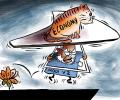
The country's new economic roadmap highlights the importance of creating a virtuous cycle of investment, savings and exports in order to sustain rapid economic growth over the next five years.

India's real estate market is poised for growth across categories - residential, commercial, and rental. Currently valued at Rs 24 trillion, or about $300 billion, it is projected to surge to $1.3 trillion by 2034, and then grow further to $5.17 trillion by 2047, indicates a report by the Confederation of Real Estate Developers Associations of India (Credai).

The Economic Survey called for improving business environment.

India's manufacturing sector saw a slower growth rate for the second straight month in May but stayed firmly in expansion mode with global sales increasing to the greatest extent in over 13 years, a monthly survey said on Monday. The seasonally adjusted HSBC India Manufacturing Purchasing Managers' Index (PMI) fell from 58.8 in April to 57.5 in May, signalling a slower but substantial improvement in the health of the sector. The index had climbed to a 16-year high of 59.1 in March.

Stressing that economic growth will only move upwards, the Reserve Bank of India Governor Shaktikanta Das on Friday pegged the GDP growth rate for the next financial year at 10.5 per cent, though a tad lower than the government's projection of 11 per cent. The projection is in line with the estimates in the Union Budget 2021-22 presented in Parliament earlier this week. The Economic Survey, tabled by the government in Parliament recently, has projected that the economy will grow at 11 per cent, up from an estimated historic decline of 7.7 per cent in 2020-21, on account of the COVID-19 pandemic.

Few finance ministers announce any taxation measure that could upset the stock market. Ms Sitharaman decided to take that risk, observes A K Bhattacharya.

Brokers believe that the higher charges may not completely deter investors from taking bets in F&O but could help cool down some activity, as the threshold to break even rises.

Most Indian chief executives are optimistic about the economy and believe it would improve in the coming 12 months, said a survey by consulting and auditing firm PwC on Tuesday. The company's 27th annual global survey polled 4,702 chief executive officers (CEOs) in 105 countries and territories, including 79 in India, from October 2 to November 10, 2023. As many as 86 per cent of CEOs in India - 30 per cent higher than a year ago - are confident that the economy would improve.

Investment in infrastructure was necessary for the economy, as power shortages, inadequate transport and poor connectivity affect overall growth performance, as per the Economic Survey 2019-20 tabled in Parliament by Union Finance and Corporate Affairs Minister Nirmala Sitharaman. "To achieve GDP of USD 5 trillion by 2024-25, India needs to spend about USD 1.4 trillion (Rs 100 lakh crore) over these years on infrastructure so that a lack of infrastructure does not become a constraint to growth," it said.

A query has been raised about the "missing" Rs 1.7 trillion fiscal hole in India's financial accounts. This is so because the Budget uses the revised estimates, a projection of how much the government was expected to earn, while the Economic Survey uses the first actual numbers.

Canada was behind India at the fifth place with 65 per cent economically confident citizens.

The adjusted gross revenue (earnings from sale of telecom services) of the top three telecom companies in India - Bharti Airtel, Vodafone India and Idea Cellular declined by 7.98 per cent, 5.14 per cent and 4.91 per cent respectively during third quarter of 2016-17.

The party also promised reservation to minorities on basis of their population after the caste census.

'The China opportunity, the digital opportunity and the end of geography opportunity are the three pieces of luck India got due to Covid.'

Our caste warriors will not even ask these questions, let alone explore better solutions to address the problems of inequality and skewed life outcomes, argues R Jagannathan.

Services sector activities in India picked up marginally in February on the back of better demand conditions and the retreat of the coronavirus pandemic but the rate of expansion was the second-slowest since last July and subdued by historical standards, according to a monthly survey. Reflecting a moderate rate of expansion, the seasonally adjusted IHS Markit India Services Business Activity Index rose to 51.8 in February from 51.5 in January. "The upturn was attributed by panellists to greater bookings, better demand conditions and the retreat of the pandemic. "That said, the latest increase was subdued by historical standards, with some companies indicating that growth was dampened by competitive pressures, COVID-19 and higher prices," the survey released on Friday said.

The report highlights that India's population in 2036 is expected to be more feminine compared to the 2011 population, as reflected in the sex ratio which is projected to increase from 943 in 2011 to 952 by 2036, highlighting a positive trend in gender equality.

The proposed units comprise seven coking coal washeries and 13 non-coking coal washeries.

It said while Indian IT services companies were the "disruptors" and had created the modern offshoring industry, they are now incumbents, challenged by a host of specialised and niche start-ups that have emerged in the new digital environment.
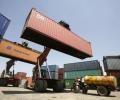
On the other hand, 16 or half of all states and Union Territories account for only 3 per cent of all exports.

Notably, Pakistani journalist Ali, cited the BBC documentary on the 2002 Gujarat riots and said he "regretted" that no US official had criticized it, while the US State Department highlighted the close relationship between the two countries, especially over shared values.

The fiscal deficit, as per the survey, deteriorated to 5.8 per cent of the GDP as compared to 3.4 per cent for 2018-19 estimated in the interim Budget.

Chief Economic Advisor Krishnamurthy Subramanian said China imports a lot of components, parts, assembles and integrates and then exports them.

Eminent economist Arvind Panagariya has said India is on the cusp of returning to a high growth trajectory and voiced confidence that the country will become the world's third-largest economy by 2027-28. Currently, India is the fifth largest economy "so it's another five years.We are already in (the year) 2023. "So 2027-28, India should be the third-largest economy," Panagariya, Columbia University Professor and former Vice Chairman of NITI Aayog, told PTI in an interview in New York.

The United States is the only western nation which ranked in the top 10.
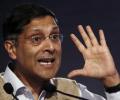
New estimates of India's gross domestic product (GDP) are "puzzling", Arvind Subramanian, chief economic adviser at the finance ministry, said on Friday.

India's manufacturing sector continued with its robust performance in November, mainly on the back of substantial easing in price pressures and strengthening demand from clients, a monthly survey said on Friday. The strong performance of the manufacturing sector is expected to continue in 2024 as well. The seasonally adjusted S&P Global India Manufacturing Purchasing Managers' Index (PMI) rose to 56 last month from the eight-month low level of 55.5 recorded in October.

Online video platform YouTube's ecosystem has contributed over Rs 10,000 crore to India's GDP and supported more than 7.5 lakh full-time equivalent jobs in the country, according to a report. In India, over 4,500 channels had over 10 lakh subscribers and the number of YouTube channels in India making Rs 1 lakh or more in their annual revenue increased by over 60 per cent year-over-year in 2021, the YouTube Impact Report based on analysis by Oxford Economics said. "YouTube's creative ecosystem contributed over Rs 10,000 crore and supported more than 7,50,000 full-time equivalent jobs in the Indian economy in 2021. "That economic impact shows up in four ways, through direct, indirect, induced, and catalytic impacts," the report said.

The Budget would preserve macro-economic stability.

India's services sector growth eased slightly in April but growth of new business and output remained sharp and among the fastest in 14 years amid favourable economic conditions and strong demand, a monthly survey said on Monday. The seasonally adjusted HSBC India Services Business Activity Index fell from 61.2 in March to 60.8 in April, highlighting one of the strongest growth rates seen in just under 14 years. Survey members attributed the latest upturn in output to favourable economic conditions, demand strength and rising intakes of new work.

In a few hours the Government of India will table the Economic Survey for fiscal 2003-04. Economic Survey is always presented a day before the Annual Budget is announced by the Finance Minister. Take the Rediff Business Quiz and find out how much you

Fitch Ratings on Thursday raised its forecast for India's economic growth to 7 per cent for the next fiscal year starting April 1 on the back of strong domestic demand and sustained level of business and consumer confidence. With a stronger-than-expected 8.4 per cent growth in gross domestic product (GDP) during the third quarter (October-December) of the current fiscal year, Fitch saw the Indian economy expanding 7.8 per cent in 2023-24 financial year (April 2023 to March 2024), marginally higher than the government's estimate of 7.6 per cent.

As the Congress batted for a national caste census with an assertion that rights should be proportionate to population, its senior leader Abhishek Singhvi on Tuesday created a flutter by saying "it will eventually culminate into majoritarianism", a remark he later withdrew from social media and blaming it on his staff.

'It feels like Assam is good just as a tourist spot and not a place to earn and live.'
 © 2026 Rediff.com - Advertise with us - Disclaimer - Privacy Policy - Sitemap - Feedback - About us - Terms of use - Grievances